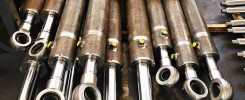
The rod is the most heavily stressed moving component in a hydraulic cylinder. It slides through seals under pressure, bears side loads, and is exposed to corrosion, impact and abrasion. A substandard rod does not merely wear out early — it damages seals, scores the barrel, and causes the entire cylinder to fail. Choosing the right hydraulic cylinder rod supplier is therefore a decision about total cost of ownership, not just unit price.
1. Why the Rod Deserves Scrutiny
Unlike the barrel or end caps, the rod is in constant dynamic contact with the seal system. Its surface quality directly dictates seal wear rate. A rod with poor surface finish or inconsistent hardness will abrade seals within months, leading to external leakage and pressure loss. In mobile machinery — where downtime can cost thousands per hour — this makes rod quality a profitability issue, not a technical detail.
A reliable hydraulic cylinder rod supplier understands this dynamic and controls every variable that affects seal compatibility: material, heat treatment, surface coating, diameter tolerance and surface roughness.

2. Critical Quality Factors to Evaluate
2.1 Base Material
Most industrial rods use CK45 / SAE 1045 medium carbon steel, which offers a good balance of machinability and strength after induction hardening. For higher-strength applications, 42CrMo4 (AISI 4140) is common. Corrosive environments — marine, offshore, chemical — require stainless steel (304 / 316 / 17-4PH) or nickel-chromium plated carbon steel.
A supplier should be able to provide material certificates (EN 10204 3.1) for every batch. If they cannot, that is a red flag.
2.2 Surface Hardness
Induction-hardened rods typically reach 50–60 HRC on the surface, with a hardened depth of 0.5–1.5 mm. This hardness resists denting and scratching from debris. A supplier that cannot specify hardness range and case depth is not controlling a critical parameter.
2.3 Surface Finish and Coating
The industry standard for rod surface roughness is Ra 0.2–0.4 µm after chrome plating. A rougher surface accelerates seal wear; a mirror-smooth surface can actually reduce lubrication retention. The optimal range is narrow, and precision grinding + polishing is what achieves it.
Hard chrome plating (20–50 µm) remains the most common coating for abrasion resistance. For severe corrosion, nickel-chrome duplex plating or HVOF thermal spray (WC-Co or Inconel) are used. Ask the supplier which coating they recommend for your specific operating environment — a one-coat-fits-all approach is a sign of limited engineering capability.
2.4 Diameter Tolerance and Straightness
Rod diameter tolerance should be h8 / h9 for standard cylinders, and tighter (h7) for high-precision applications. Straightness is typically 0.05 mm per meter. Deviations cause uneven seal loading, binding, and premature wear.
3. Questions to Ask Before Placing an Order
- Can you provide EN 10204 3.1 material certificates for each heat?
- What is the guaranteed surface hardness range and case depth?
- What is the minimum chrome plating thickness, and is it measured per batch?
- Do you perform 100% dimensional inspection or sampling?
- What is the lead time for custom diameters and lengths?
- Can you supply sample rods for seal compatibility testing?
- What is your maximum rod length and diameter capacity?
4. Total Cost of Ownership, Not Unit Price
A rod that costs 15% less but fails after 2,000 hours is far more expensive than a rod that costs 15% more and lasts 8,000 hours. The failure cost includes not just replacement, but machine downtime, seal replacement, labor, and potential environmental penalties from hydraulic fluid leakage.
When evaluating a hydraulic cylinder rod supplier, ask for field performance data or reference applications in your industry. A supplier with documented track records in similar operating conditions reduces your risk significantly.
Conclusion
Selecting a hydraulic cylinder rod supplier is an engineering decision. Material grade, hardness, surface finish, plating quality and dimensional precision collectively determine how long your cylinders will perform reliably. By focusing on these technical parameters — and asking the right questions — buyers can avoid the hidden costs of premature rod failure and build a supply chain that supports long-term equipment reliability.